In 2026, shoppers increasingly ask, “how long does biodegradable food packaging take to decompose?” The honest answer depends on the material, temperature, moisture, oxygen, and disposal site. A certified compostable tray may break down within several weeks or months in an industrial composting facility. It may remain almost unchanged for years in a dry landfill.
The setting matters greatly.
Professor Ramani Narayan, a polymer scientist at Michigan State University, has explained: “Biodegradability is a function of the environment, not a property of the material.” His point challenges a common assumption. A package labeled biodegradable does not automatically disappear in a backyard compost pile. Some materials need controlled heat, steady moisture, and active microbial conditions. Others break down more slowly, especially when food residue, cold weather, or poor airflow interferes.
This guide examines realistic decomposition timelines for common biodegradable food packaging. It considers molded fiber, paper coatings, compostable plastics, and plant-based films. It also separates laboratory results from everyday disposal experiences. That distinction matters.
A clean-looking package can still leave fragments.
Manufacturers may report impressive testing results. Yet those results often come from carefully managed facilities. Household composting is less predictable. Collection systems also vary between communities, creating another weak point in the process.
There is no single timeline.
Readers should treat decomposition claims as conditional, not guaranteed. The most useful answer combines scientific evidence, packaging standards, and practical experience. Even then, uncertainty remains. That is not a failure of research. It is the reality of biodegradable packaging in different environments.
2026 How Long Does Biodegradable Packaging Take to Decompose?
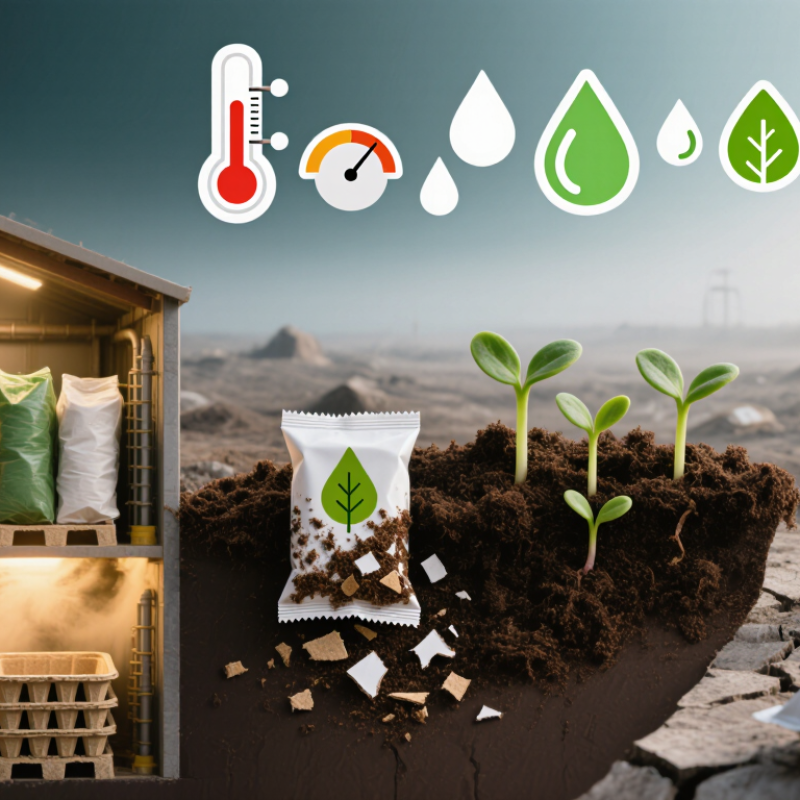
In 2026, biodegradable packaging means materials that microorganisms can break down under suitable conditions. It does not mean the package disappears anywhere. Soil, heat, moisture, oxygen, and microbial activity all affect decomposition speed. A thin fiber tray may break down within weeks in an industrial composting facility. A coated pouch may need several months or longer. Some materials may not decompose well in a backyard compost bin.
Look closely at the disposal instructions. “Biodegradable” is not the same as “compostable.” Compostable packaging should meet defined testing conditions and leave no harmful residue after treatment. Reliable information should identify the required facility, temperature range, and expected timeframe. Clear certification and third-party testing also matter. Vague claims create avoidable confusion.
A practical check is simple. Tear the package, inspect its coating, and find local disposal guidance. Food residue can also change the process. A clean paper container may enter a suitable compost stream, while a laminated version may require another route. The uncomfortable truth is that many consumers still lack access to proper facilities. I also find the word biodegradable too broad for everyday decisions. Packaging can be technically biodegradable yet useless without the right collection system. Better labeling should explain where it belongs, not merely promise that nature will handle it.
Biodegradable packaging is not one material, and decomposition time depends on its chemistry and disposal conditions. PLA, made from plant sugars, is clear and rigid. It usually needs industrial composting, controlled heat, moisture, and airflow. Under EN 13432 conditions, certified compostable packaging should disintegrate within 12 weeks and biodegrade within six months, according to European Bioplastics guidance.
PHA uses microbial fermentation to create flexible films and coatings. It can biodegrade more broadly than PLA, but performance still depends on thickness, temperature, and local composting systems.
Starch blends are inexpensive and useful for films or loose-fill protection. They absorb moisture easily, which can be helpful during composting but inconvenient during storage.
Cellulose paper, molded fiber, and bagasse use plant fibers for trays, sleeves, and cartons. Their fiber structure breaks down more readily, although water-resistant coatings may slow the process.
European Bioplastics and nova-Institute project global bioplastics production capacity to rise from about 2.18 million tonnes in 2023 to 7.43 million tonnes by 2028. Growth is significant, but infrastructure remains uneven. UNEP’s 2023 report identifies packaging as the largest single-use plastic application. The label can mislead. A PLA cup placed in ordinary soil may remain visible for years, despite its compostable certification. Material selection should match the available waste system, not only the raw ingredients.
Biodegradable packaging does not decompose at one fixed speed. Paper bags and uncoated cardboard may break down in two weeks to six months under warm, moist composting conditions. Molded fiber trays often take one to six months. Ink, coatings, and food residue can change the timing.
Starch-based films may decompose within one to six months in an active commercial composting facility. Certified compostable bioplastics commonly need around three to six months under controlled industrial conditions. They may remain unchanged in a cool backyard pile.
Temperature, moisture, oxygen, and microbial activity all matter.
Some packaging uses wood fiber or other dense plant materials. These items can take several months or even a few years to disappear. Conventional plastic packaging is different. It may persist for decades or centuries, even when it becomes brittle or breaks into smaller fragments. That is not the same as biological decomposition.
The label alone can mislead. “Biodegradable” does not always state where decomposition occurs or what remains afterward.
A reliable assessment should consider the material, thickness, additives, and disposal environment. Real-world timing is messier. A damp compost facility and a dry landfill produce very different results. Checking testing information and local collection rules gives a more realistic estimate than relying on a simple number.
Biodegradable packaging does not decompose at one fixed speed. Temperature, moisture, oxygen, microbes, and packaging thickness control the process. Under ASTM D5338 testing, industrial composting commonly maintains temperatures near 58°C. ASTM D6400 also uses a 180-day window for substantial carbon conversion. These are controlled conditions, not ordinary soil.
Moisture is critical. Composting materials often perform best when moisture remains near 50–60%, according to professional composting guidance. Too little water slows microbial growth. Too much water removes oxygen and creates compact, sour-smelling layers. A sealed film may look unchanged after months if airflow cannot reach its surface.
Heat matters, but heat alone is insufficient. The European Bioplastics 2024 market update stresses that many compostable materials require industrial composting systems. Backyard piles may remain cooler, drier, and less active. Food residue can accelerate breakdown by supporting microbes, although coatings, inks, and adhesives may behave differently. Field conditions remain inconsistent. I have seen decomposition claims treated as promises, when they are really test results. Certification data should therefore identify temperature, humidity, oxygen levels, and the testing period. Without those details, “biodegradable” says very little about what happens beside a garden path.
| Packaging Material | Most Suitable Decomposition Environment | Typical Temperature | Moisture and Oxygen Requirements | Estimated Decomposition Time | Main Conditions That Control the Rate | Important Limitation |
|---|---|---|---|---|---|---|
| Paper and uncoated cardboard | Home composting, commercial composting, or moist soil with active microorganisms | 20–60°C | Moist but not waterlogged; aerobic airflow supports faster breakdown | Several weeks to 6 months | Fiber thickness, ink and coating, moisture, oxygen, microbial activity, and shredding | Wax, plastic, foil, or heavy water-resistant coatings can greatly delay decomposition. |
| Uncoated molded fiber or bagasse | Active home or industrial composting | 25–60°C | Consistent moisture and good aeration are required | About 1–6 months | Wall thickness, surface area, temperature, moisture, oxygen, and carbon-to-nitrogen balance | Dense or heavily pressed items generally decompose more slowly than loose fibers. |
| Starch-based loose-fill packaging | Moist compost or soil containing microorganisms | 15–35°C | Requires moisture; aerobic conditions usually accelerate biological activity | Days to a few months | Humidity, temperature, exposed surface area, and contact with microbes | It may dissolve or fragment quickly in water, but physical disappearance does not always mean complete biodegradation. |
| PHA-based packaging | Industrial compost, soil, freshwater, or marine environments, depending on formulation | 20–60°C | Moisture and microbial activity are important; oxygen may affect the pathway | Several months to 2 years | Polymer composition, thickness, temperature, humidity, microbial population, and environment | Decomposition is formulation-specific and can be substantially slower in cold or low-microbial environments. |
| PLA film, tray, or rigid packaging | Commercial or industrial composting with controlled heat and humidity | Approximately 55–60°C | High moisture, active aeration, and regular compost mixing are normally needed | About 3–6 months under suitable industrial conditions | Temperature, humidity, thickness, pretreatment, and exposure to compost microorganisms | PLA commonly persists much longer in backyard compost, soil, landfill, or marine conditions. |
| PBAT-containing compostable film | Industrial composting with sustained heat, moisture, and aeration | Approximately 55–60°C | Warm, humid, oxygen-rich compost conditions are generally favorable | About 3–6 months under certified composting conditions | Blend composition, film thickness, temperature, moisture, oxygen, and compost maturity | A compostable claim applies only under the conditions specified by the applicable certification or test method. |
| Cellulose film or regenerated cellulose | Moist soil or aerobic compost, provided it has no persistent plastic coating | 20–60°C | Needs moisture and microbial contact; coatings can restrict water penetration | Several weeks to several months | Degree of regeneration, coating type, thickness, moisture, temperature, and oxygen | A cellulose-based film with synthetic barrier layers may not decompose like plain cellulose. |
| Wood or bamboo fiber packaging | Moist aerobic compost or soil | 20–60°C | Moisture, oxygen, and fungal activity are important; larger pieces break down more slowly | Several months to 2 years | Wood density, lignin content, particle size, temperature, moisture, and microbial activity | Thick, resin-treated, painted, or laminated components may remain for much longer. |
| Compostable multilayer packaging | Only the specific composting environment stated by the product certification | Often 50–60°C for industrial composting | Requires adequate moisture, oxygen, and active compost management | Several months to more than 1 year | Layer chemistry, adhesive type, total thickness, temperature, moisture, and oxygen transfer | Multilayer structures often decompose more slowly than single-material packaging and may leave fragments if conditions are unsuitable. |
| Conventional petroleum-based plastic packaging | No reliable biological decomposition pathway in ordinary composting | Variable; normal compost temperatures are usually insufficient | Moisture and oxygen may cause slow weathering, but not rapid biodegradation | Many decades to centuries | Ultraviolet exposure, oxidation, physical abrasion, temperature, and material formulation | Fragmentation into smaller pieces or microplastics should not be treated as biodegradation. |
Interpretation: Decomposition times are indicative ranges rather than guarantees. Actual performance depends on the complete packaging formulation, item thickness, preparation, temperature, moisture, oxygen availability, microbial activity, and the management of the receiving facility. Industrially compostable packaging may not decompose within the same period in a backyard compost bin, landfill, soil, or marine environment.
2026 How Long Does Biodegradable Packaging Take to Decompose?
Biodegradable packaging does not disappear immediately after disposal. Its breakdown may take weeks, months, or several years. Temperature, moisture, oxygen, and microorganisms all affect the process. Industrial composting usually provides controlled heat and airflow. Ordinary soil may not. A package labeled biodegradable can still remain visible for a long time in a landfill.
Dispose of it according to the exact label and local waste instructions. Remove food scraps first, because contamination can damage recycling or composting streams. If the package is certified for industrial composting, place it in the correct compost collection bin. Do not put it in a home compost pile unless the instructions clearly permit it. Some facilities reject these items. I have sometimes assumed “biodegradable” meant “safe anywhere,” but that assumption was wrong.
Tips: Check the disposal symbol before throwing anything away. Keep packaging dry when recycling. Cut off stickers, handles, or mixed-material parts when required. Never leave biodegradable packaging outdoors as litter. Ask your local waste authority about accepted materials, because collection rules differ between communities. When no suitable facility exists, regular waste may be the more responsible choice. It feels disappointing, but honest disposal prevents contamination and protects the system.
The chart shows approximate decomposition or disintegration times under managed composting conditions. Paper and molded-fiber packaging generally breaks down within weeks to a few months, while certified compostable bioplastics may require several months in a commercial composting facility. In landfill or marine environments, decomposition can be much slower or may not occur effectively because of limited oxygen, moisture, and microbial activity.
To dispose of biodegradable packaging correctly, check the packaging certification and local waste rules. Place certified compostable items in an accepted commercial composting stream, recycle clean paper-based packaging where permitted, and do not put compostable plastics in conventional recycling unless local authorities specifically allow it.
Paper bags may break down within two weeks to six months. Molded fiber trays often need one to six months. Some dense plant-fiber items may take several years.
Not always. Many starch-based films need one to six months in active industrial composting. A cool, dry backyard pile may leave the film unchanged.
Warm temperatures, steady moisture, oxygen, and active microorganisms help. Industrial composting often maintains temperatures near 58°C. Moisture around 50–60% can support microbial activity.
Yes. Excess water removes oxygen and creates compact, sour-smelling layers. Too little water also slows microbial growth. Balanced moisture matters.
Usually, decomposition is slow or incomplete there. Landfills may lack oxygen, moisture, and active microbes. A package can remain visible for a long time.
No. The label may not explain the required temperature, humidity, or disposal site. Thickness, coatings, inks, adhesives, and food residue can change the timing. The label alone is insufficient.
Only when the instructions clearly allow home composting. Many certified items require controlled industrial conditions. Putting them into the wrong bin may contaminate an entire compost stream.
Check the disposal symbol and local collection rules. Remove food scraps before recycling or composting. Separate stickers, handles, and mixed-material parts when required. Never leave the package outdoors as litter.
Regular waste may be the more responsible option. This feels disappointing. Avoid sending unsuitable packaging into recycling or composting systems. I once assumed “biodegradable” meant safe anywhere, but that was wrong.
In 2026, biodegradable packaging refers to packaging made from materials that can be broken down by microorganisms under suitable environmental conditions. Common materials include paper-based fibers, starch blends, plant-based films, cellulose, and compostable biopolymers. The time required for decomposition varies widely: some paper products may break down within weeks or months, while thicker molded fibers and specialized compostable films may take several months or longer. This means the question “how long does biodegradable food packaging take to decompose” cannot be answered with one fixed timeframe.
Temperature, moisture, oxygen, microbial activity, and the availability of industrial composting facilities all influence decomposition speed. Packaging placed in a dry landfill or discarded outdoors may remain intact much longer than packaging processed in a controlled composting environment. To dispose of it correctly, consumers should check the package instructions, separate food residue, and use an appropriate composting or waste-collection system. Biodegradable does not automatically mean suitable for home composting or natural disposal.

PsiPrime Packaging